Pages

Wednesday, January 30, 2013

Text Features

During our Egypt unit, we spend the majority of our time on non-fiction Egyptian selections.  There are a huge number of books out there that grab kids'attention and really get them interested in the Egyptian culture.    I have about 75 of those books, and the kids love sorting through them and comparing what they've read.  This post is NOT about one of those texts :)

This post is focusing on one of those other kinds of texts-the kind that kids don't really love to read, but unfortunately does a great job of breaking down the information they need about a particular topic.  During today's class, we spent our time working in pairs with a general "Ancient Egypt" article.  The article itself was about 6 pages long, but it was interspersed with loads of pictures, graphics, sidebars, charts, and captions.  There were also several thought-provoking questions that required activating their schema, making connections to those other texts, and using the information in the article itself.

While working, to make it a little more tactile, I handed out highlighters and mini Post-It notes to each student.  They were allowed to use the highlighters to highlight important information, and use one Post-It per page to record one text feature they found.  While I use Post-Its almost daily in my room, I almost never use highlighters.  For one, they aren't allowed to use them on the state test, so I like them to be familiar with simply underlining.  But also, I find that they blatant overuse of highlighting text to be so frustrating!  They get so into using colors that they often end up highlighting the entire text...which is worse than highlighting nothing!  But, I think that every once in a while it's good, because it gets them out of a rut and lets them have a little fun, especially while reading something that can get a little monotonous.

Our text features anchor chart

My own version of a Post-It note (what else can I use my yellow dry-erase markers for?!)


What lessons do you create for your class to make things a little more engaging?

Sunday, January 20, 2013

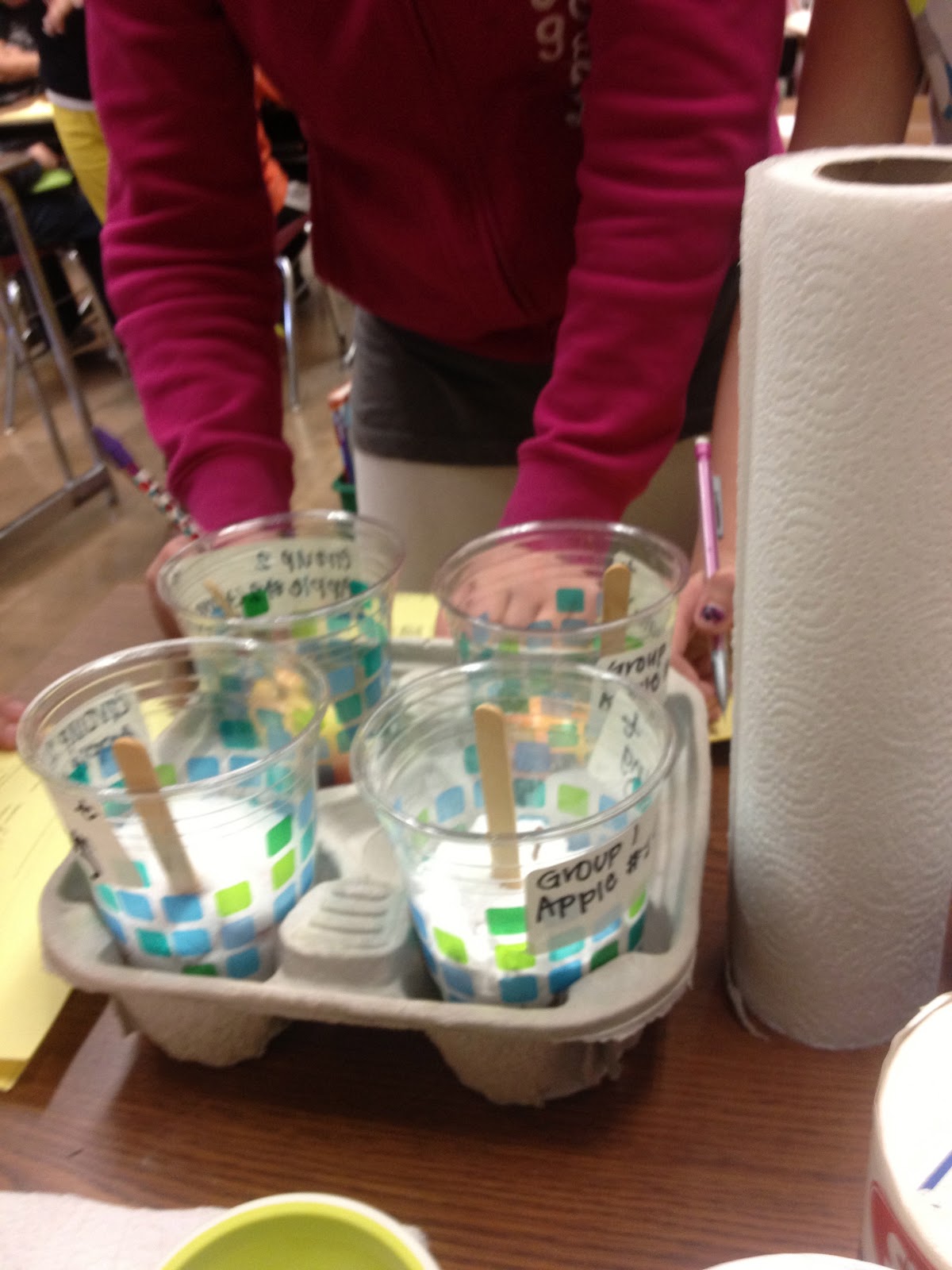
Apple Mummification

We are knee-deep in our Egypt unit over here in the 6th grade.  This means pyramids, pharaohs, and especially mummies.  To really emphasize the mummification process, we spend a day mummifying apples, then observe them for the rest of the week.  We take notes on the size, look, smell, and overall decay on these apples.  Each group of 4 students receives 2 apple halves, and preserves them in different substances (table, salt, epsom salts, baking soda, and combinations of each of these).  We also have one apple left alone to act as our control (for a non-science teacher, I'm proud of myself for even knowing this).

The kids really enjoy the process and get into the idea of their apple mummies.  They usually get over the "gross rotting factor" pretty quickly and do a pretty good job on their observations.


Spoiler Alert:  They all essentially decay at the same rate, no matter the substance in which they've been preserved! (Well, except for the control, of course, which was pretty disgusting by the end of the week).

What hands-on activities have been happening in your classroom?

Wednesday, November 28, 2012

Reading to Self

As part of the Daily 3, my students have plenty of time to read to themselves. They are encouraged to move around the room and find a comfortable spot to set up and delve into their books.  My room is set up with a coffeehouse theme, but I had to draw the line at comfy couches, pillows, and rugs.  The cost of those items aside, I couldn't deal with the lice & bed bugs that would undoubtedly accompany those fluffy, comfy seats.

However, while 'shopping' at Crayons to Computers I found these great yoga mats.  Soft on one side, rubbery on the other.  (And $29.99 at Target...holy cow! Have I mentioned how lucky we are to be able to shop at Crayons!?)
And they were much too large to have 20 kids spreading them out all over my room.
Not to mention, there was a limit of 2 mats per person.  So I asked a few co-workers to grab them & send them my way, and quickly accumulated 10.  I chopped them in half and voila...reading mats for every student!


What does Read to Self (or your version of silent reading) look like in your room?


Sunday, November 25, 2012

Student Council

If I'm honest, I want nothing to do with the idea of student council.  Really.  It seems like a lot of work, and I've got a pretty full plate.  One of my goals this year is to say "no" more often, so I can focus more energy on fewer things that are important to me.  So when I was approached by one of my students, Tiandra, about starting a student council, I hesitated.  I put it off.  Finally, I told her that if she put together a proposal that outlined what she envisioned "student council" to be, I'd look it over.

3 full, hand-written pages later, I felt like I couldn't say no.  She'd put so much thought into this concept, I had to say yes.  A lot of her ideas were far-fetched and impractical, but a lot of them were REALLY good.  Her idea of a student council that focused on community service, creating a sense of camaraderie between students, and eliminating bullying really spoke to me.
After reviewing with Tiandra what we both deemed important to the student council, I set up the rules for each position:  president, vice-president, secretary, & treasurer.  I outlined the expectations for the campaign, their speeches, and the election itself.

Each candidate had to submit an application, and in turn, received 4 blank posters to create their election posters.


They had a week to put up posters, give out stickers, and campaign during recess & lunch.  Then each candidate had 3 minutes to give a speech to convince their fellow classmates why he/she was the best person for the job.  Most of the candidates' speeches didn't come close to that limit, but they put a lot of effort in to it.  I applaud the students who stood up in front of a crowd of people and give a speech.  It takes courage & I don't think I would have had the guts to do it when I was in 6th grade.


After the speeches, the students returned to the classrooms and voted.  I tallied their votes and announced the winners at the end of the day.  There were a few tears, but overall I think the students elected some great candidates.  Unfortunately, Tiandra, our original organizer, was not elected, but she will still have an important role as the council develops.  I'm excited to see what they have in store for their classmates (and me!) as the year continues!

What does student council look like for your school?  Any ideas as I get this off the ground?!

Tuesday, November 6, 2012

Signature...finally

My friend Maria at Curious Firsties is awesome.  She helped me finally insert a signature to this blog-because I clearly couldn't figure it out by myself.  Yep, I should have figured this out on my own.  But I kept inserting the wrong code or putting the right code in the wrong spot.  Finally, it's done.  Now it feels like a real blog!  Thanks, Maria!!

Cast Your Vote

Election Day!  For my students, this means NO SCHOOL, as our buildings are used as polling places.  For me, it means INSERVICE DAY, where I spent my day working with my colleagues (and had a full hour to eat lunch!  at a restaurant!  with other people!).  But I digress.  The election process is one that my students still need exposure to and help wading through, especially in a presidential election year, so I planned to teach my lesson on the day before...and hope they could learn something to go home and maybe teach their someone else a thing or two.

I found a really fantastic lesson on the election process/electoral college on the blog One Hoosier Teacher.  Check it out here.  I found it a long time ago and saved it (thanks, Pinterest), knowing I'd need a great lesson for the first Tuesday in November.  I pretty much mimicked her whole lesson since it was perfect, but I did adapt a couple of things for my class.

As I began the lesson on the electoral college, I reminded my class that the electoral college is NOT a place of higher education, not a place to where they can earn a football scholarship, and certainly not a place with dorm rooms & fraternity parties :)

It's a confusing process, this electoral college, and it's one that I'd venture to say many adults don't totally understand.  I used the book Grace for President as my read aloud for the day.  The book does a decent job of explaining the electoral college in a humorous manner.

Then we viewed this infographic.  It helped the kids to see the process on the screen and actually be able to follow it.  When I felt like we had a pretty good working knowledge of the process, we moved on to their own voting process.

I have 20 students in my morning class, and 18 in my afternoon class.  In order to reach our quota of 51 (50 states plus Washington, DC), I also asked other teachers and staff members to vote in our election.  Then I gave each student a slip of paper with his or her own state on it, and gave them a minute to find their state on the map & find their number of electoral college votes.  Some kids complained about their low number, but that made me feel like they really did understand the process.

After they established their numbers, I dangled the carrot.  I told the students they'd be voting...not for Romney or Obama, but for Coke or Pepsi.  They had a minute or two to decide which soda they wanted to vote for, then I opened the polls.  They brought their state slips to the table, deposited them in the ballot box, and chose their soda.


Then we voted on the site 270towin.  My class really liked this part, and waited with anticipation to see whether the state would turn red (Coke) or blue (Pepsi).

In the end, it was a landslide.  Coke won, 323 to 209.  For those of you counting, no, that doesn't add up to 538.  I had one student who opted out of voting, claiming she didn't like Coke or Pepsi (can you imagine?!).  I used it as a semi-teachable moment...pointing out that lots of times, people opt out of voting, and even though it's your civic duty, I certainly couldn't force anyone to cast a vote.  But I also pointed out that even as one person opts to not vote, the entire state of Nevada would not ever really opt out, so those 6 electoral college votes would actually be counted in a real election.

I think the kids really enjoyed the lesson, and not just because they ended up with a can of pop.  (Yes, I know I've called it both soda and pop in this post.  What can I say-I grew up in Buffalo, NY, but live in Cincinnati, OH.  I haven't fully converted to the dark side!)